Demystifying AI in Fraud Detection: Balancing Machine Learning Speed with Regulatory Transparency
As financial institutions deploy complex machine learning models to combat sophisticated fraud in real time, they face a critical hurdle: the "black box" problem. Here is how modern fintechs can architect Explainable AI (XAI) frameworks to maintain millisecond latency while satisfying strict regulatory audit standards.
Legacy rule-based fraud engines are rapidly becoming obsolete. Hardcoded IF-THEN parameters struggle to catch modern, organized financial crime, which adapts in real time across fragmented digital touchpoints.
To bridge this gap, financial institutions have turned to advanced machine learning architecture—ranging from Gradient Boosted Decision Trees (like XGBoost) to Deep Neural Networks. These models analyze thousands of variables per transaction in milliseconds, spotting subtle anomalies that static rules miss.
However, this predictive power introduces a complex engineering and operational paradox: the more complex the model, the harder it is to explain.
When a neural network flags a transaction as high-risk, blocks an instant payment, or declines a credit line, risk teams and regulators demand to know why. Bridging the gap between high-speed prediction and regulatory compliance requires building Explainable AI (XAI) directly into the product architecture.
The Black Box Risk in Financial Operations
In fintech, a black box decision engine creates systemic operational friction across three primary vectors:
- Regulatory Non-Compliance: Regulators globally—from the European Union’s AI Act to the Fair Credit Reporting Act (FCRA) in the US—mandate transparency in automated decision-making. Regulated entities must be able to state the exact logic behind adverse action notices or frozen accounts.
- Audit & Governance Failures: External auditors and internal compliance officers cannot validate uninterpretable models. Without data lineage and clear feature weighting, proving a model is free from demographic bias or data leakage becomes nearly impossible.
- High False-Positive Friction: When risk teams cannot quickly determine why an automated flag was triggered, customer support representatives spend double the time manually reviewing transactions, increasing operational expenditure and alienating legitimate users.
To scale safely, machine learning operations (MLOps) in fintech must treat explainability not as a post-hoc legal check, but as a core system feature.
Architecting Explainability: SHAP, LIME, and Feature Attribution
Achieving transparency in high-dimensional models relies on mathematical frameworking that translates complex vector operations into human-readable scoring. Two primary methodologies have emerged as industry standards:
SHAP (Shapley Additive exPlanations)
Based on game theory, SHAP assigns each feature an importance value for a particular prediction. It measures how much a specific data point (e.g., IP location distance, transaction frequency in the last 10 minutes, or device fingerprint change) pushed the model’s risk score above or below the baseline threshold.
LIME (Local Interpretable Model-agnostic Explanations)
LIME works by approximating a complex, non-linear machine learning model locally around a specific prediction. By creating a simpler, interpretable surrogate model (like a linear regression) for that single instance, LIME explains individual high-risk flags without needing to unravel the entire global neural network.
By integrating these tools, risk engineering teams can attach an attribution payload to every API call that outputs a risk decision.
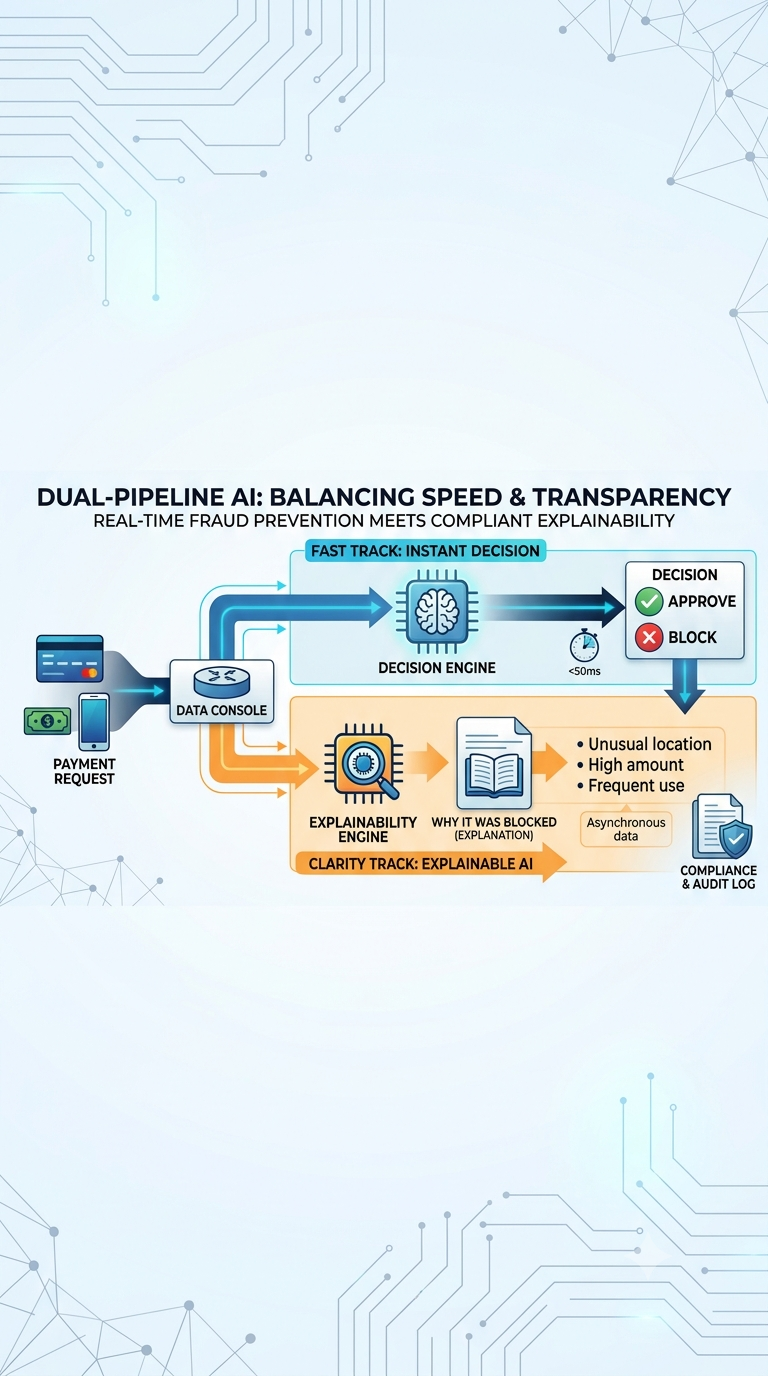
The Dual-Pipeline Architecture: Solving the Latency Problem
Calculating SHAP values or running surrogate models dynamically in real time can degrade API performance, turning a 50-millisecond checkout response into a 2-second bottleneck.
To preserve rapid execution while retaining full transparency, modern fintech architectures employ an asynchronous explanation pipeline:
[ Incoming Transaction ]
         │
         ▼
┌─────────────────────────┐
│ Real-Time ML Engine     │ ──(Score & Decision: <50ms)──► [ Payment Gateway ]
└─────────────────────────┘
         │
         ▼ (Async Event Stream)
┌─────────────────────────┐
│ Explanation & Log Engine│ ──(SHAP / Feature Scores)───► [ Compliance Dashboard / Audit Trail ]
└─────────────────────────┘
- The In-Line Decisioning Layer: The primary model evaluates the transaction payload against cached weights, returning an instant Pass, Review, or Block score to the transaction stream.
- The Asynchronous Explanation Layer: The transaction context, model version, and feature vector are published to an asynchronous message broker (such as Apache Kafka).
- Audit Log Generation: A background worker computes the instance-level feature attributions, writing the human-readable explanation to an immutable audit database within seconds.
If a transaction is flagged for human review or audited six months later, the compliance team has immediate access to both the decision outcome and the precise weighted factors that caused it.
Building Trust Into the Product Life Cycle
Machine learning transparency isn't solely a data science challenge; it is a cross-functional system strategy. Building explainable fraud engines requires alignment across engineering, product management, and regulatory compliance:
- Standardize Model Documentation: Maintain comprehensive model cards detailing training datasets, baseline performance, boundary conditions, and known edge-case limitations.
- Implement Human-in-the-Loop (HITL) Feedback: Ensure flagged decisions routed to risk analysts feed back into the retraining pipeline to continuously calibrate feature attribution weights.
- Maintain Versioned Data Lineage: Always log the exact version of the model, feature store state, and rule threshold used at the exact timestamp of the transaction.
When designed with transparency at its core, AI-driven fraud detection stops being a regulatory hazard and becomes a decisive competitive advantage—delivering enterprise-grade security without compromising user trust or developer speed.
Post a comment